

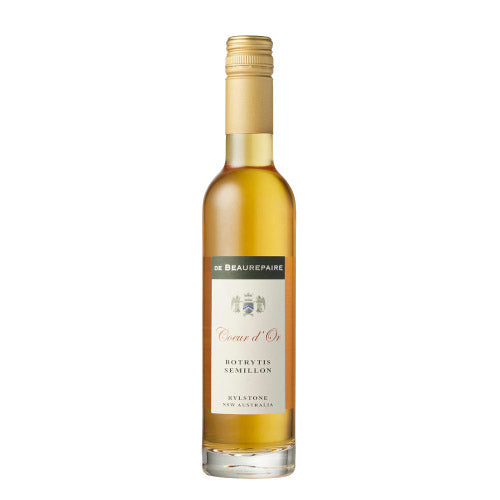
2022 'Coeur d'Or' Botrytis Semillon
$70.00
Please select all options.
- 2017 GOLD MEDAL & SECOND PLACE – 6 NATIONS WINE CHALLENGE – V 2013
- 2018 AUSTRALIAN WINE OF THE YEAR – V 2016 (WINESTATE MAGAZINE)
- 2018 AUSTRALIAN AND NEW ZEALAND SWEET WINE OF THE YEAR – V 2016
- 2019 AUSTRALIAN WINE OF THE YEAR FINALIST – V 2018
- 2025 BEST AUSTRALIAN SWEET WINE - YOUNG GUNS OF WINE - V 2022
SNAPSHOT
- Style: Noble-rot Botrytis Semillon in the Sauternes tradition — rich, golden, high-acid
- Residual Sugar: 130 g/l
- Vegan: Very lightly fined with Bentonite
- Cases produced: 233
HERITAGE
Coeur d’Or means “Heart of Gold” — a fitting name for our botrytised Semillon, inspired by the great sweet wines of Sauternes.
The ability to produce quality sweet wines from our property was a complete surprise. After years of battling botrytis in the blocks closest to the Cudgegong River, we decided in 2013 to surrender and make wine from the heavily botrytised fruit. The result was not a classic Australian “sticky”, but a high-acid, high-residual-sugar wine closer in spirit to Sauternes.
In 2018, our 2016 Coeur d’Or was named Australian Wine of the Year by Winestate Magazine — the first time a sweet wine had received that honour. The 2022 vintage continues that line: rich, complex and sweet, but carried by natural acidity rather than weight and was classified as one of Australia’s Best Sweet Wines by Young Guns of Wine in December 2025.
TERROIR
Ultra-cool inland site above Rylstone at ~650 m ASL, on Ordovician (~450 Myr) limestone reef with shallow sandy / sandy-loam soils. Low soil heat retention and valley cold-air pooling create effective night-time temperatures like ~1,200–1,300 m, preserving natural acidity, perfume and delicate red-fruit line. Continental rhythm: budburst late Sept/Oct; veraison Jan/Feb; harvest Mar/Apr. Estate planted 1998 by Richard & Janet de Beaurepaire.
VINTAGE & VINEYARD
Season 2022: A cool, wet vintage with high disease pressure across the region. For most dry table wines, botrytis risk required careful control through canopy and undervine management. For Coeur d’Or, however, selected Semillon parcels developed the noble rot needed for a serious Sauternes-style wine: intense residual sugar, lifted acidity and complex citrus-marmalade characters at modest alcohol.
Blocks / Clones: Semillon from C Block, close to the Cudgegong River, where autumn morning fog encourages slow, even botrytis development.
Harvest: Individually selected parcels harvested by a mix of hand and machine picking on 13 April.
WINEMAKING
The grapes were cold soaked, then pressed through a long, gentle cycle to extract highly concentrated juice. Fermented using Sauternes yeast, with maturation across stainless steel and French oak to build texture and complexity without overwhelming the fruit.
Analysis at bottling: Alc: 11.5% pH: 3.50 TA: 8.3 g/L RS: 130 g/L
TASTING
Colour: light golden.
Bouquet: apricot, ripe peach, marmalade, citrus peel and honey.
Palate: dry, crisp and savoury — rich, layered and textural — apricot, fresh citrus, marmalade and honey carried by excellent natural acidity. The sweetness is generous but not heavy; the acid line keeps the wine poised, fresh and long. Delicate French oak adds savoury complexity and mouthfeel without dominating the fruit.
FOOD & SERVICE
A natural with cheese plates, blue cheese, pâté, foie gras, terrines and salty desserts. Also excellent with fruit-based desserts, crème brûlée, citrus tart and dishes where sweetness meets salt or spice. As in France with Sauternes, Coeur d’Or can also be served as an aperitif — especially with rich savoury dishes where sweetness, acidity and salt work together.
Serve: 10-12 °C / 50-54°F in tulip sparkling stems or white-wine glasses.
WHY BOTRYTIS SEMILLON HERE? Great sweet wine needs more than sugar. It needs acidity, concentration, noble rot and time. Our ultra-cool limestone site gives Semillon the natural acid spine to balance high residual sugar, while river fog creates the conditions for slow, even botrytis development. The result is not a heavy Australian sticky, but a Sauternes-style wine: golden, rich and complex, yet fresh, lifted and built to age.